Transformer Model
Transformer Excitation
Theoretical Background
In the time domain, the transformer excitation voltage~$e(t)$\,[V] and magnetization current~$i^m(t)$\,[A] are related through the BH-curve:
\[\begin{align} e(t) \rightarrow B(t) \stackrel{\mbox{BH-curve}}{\rightarrow} H(t) \rightarrow i^m(t) \end{align}\]
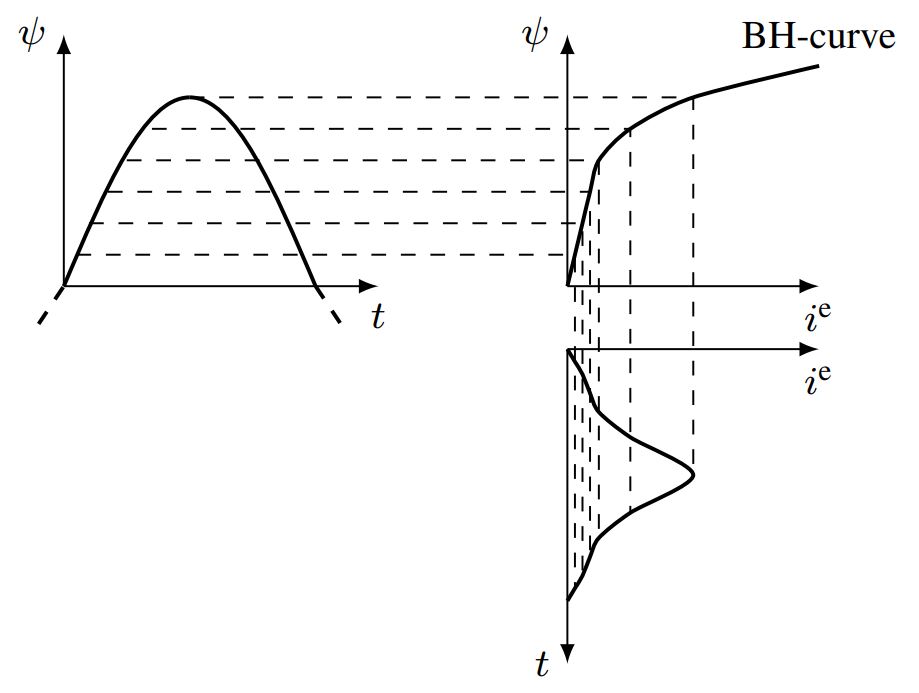
The transformer excitation voltage~$e(t)$ relates to its magnetic flux density~$B(t)$\,[T]:
\[\begin{align} B(t) &= \sum_{h \in H} \frac{|E_h|}{A \cdot \omega_h} \cdot \cos(\omega_h \cdot t + \theta_h), \\ \mbox{given:} & \nonumber \\ e(t) &= \sum_{h \in H} |E_h| \cdot \sin(\omega_h \cdot t + \theta_h), \\ B(t) &= \frac{1}{A} \int -e(t) \mathrm{d}t, \end{align}\]
where~$A$\,[m^2], $\omega_h$\,[rad/Hz], $|E_h|$\,[V] and~$\theta_h$\,[rad] denotes the core surface, harmonic angular frequency, harmonic excitation voltage magnitude and phase angle, respectively. The link between the frequency-domain excitation current~$E$\,[pu] and the time-domain excitation voltage~$e(t)$, and consequently the magnetic flux density~$B(t)$, is provided through the following functions, depending on the chosen excitation voltage formulation E_formulation, i.e., :polar or :rectangular.
Missing docstring for HarmonicPowerModels.magnetic_flux_density_polar(E::Vector{<:Real}, θ::Vector{<:Real}, ω::Vector{<:Real}, t::Vector{<:Real}, A::Real, Vbase::Real). Check Documenter's build log for details.
Missing docstring for HarmonicPowerModels.magnetic_flux_density_rectangular(Ere::Vector{<:Real}, Eim::Vector{<:Real}, ω::Vector{<:Real}, t::Vector{<:Real}, A::Real, Vbase::Real). Check Documenter's build log for details.
The transformer magnetization current~$i^m(t)$ relates to its magnetic field intensity~$H(t)$\,[Ampere-turn/meter]:
\[\begin{align} i^m(t) &= H(t) \cdot l, \end{align}\]
where~$l$\,[m] denotes the mean magnetic path. The frequency-domain magnetization current~$I^{e}$\,[pu] is determined through a Fourrier transform of the time-domain magnetization current~$i^m(t)$, adjusted for current basis. Depending on the chosen excitation voltage formulation E_formulation, the frequency-domain magnetization current is expressed in :polar or :rectangular coordinates.
Implementation
All excitation data are stored in a dictionary xfmr_exc with:
- key = id of the xfmr [
Int] - val = a dictionary [
Dict{String,Any}] consisting of the following input:- General input, including:
| key | type | description |
|---|---|---|
| "Hᴱ" | Vector{Int} | set of relevant excitation voltage harmonics |
| "Hᴵ" | Vector{Int} | set of relevant magnetizing current harmonics |
| "Fᴱ" | Symbol | excitation voltage formulation, i.e., :rectangular or :polar |
| "Fᴵ" | Symbol | magnetization current formulation, i.e., :rectangular or :polar |
| "l" | Real | mean magnetic path [m] |
| "A" | Real | core surface [m^2] |
| "N" | Int | nominal primary turns [-] |
| "BH" | Function | anonymous function for the inversed BH-curve [T//A-turns/m] |